



As women continue to expand their presence in the corporate workforce, their role in managing money is evolving alongside it. In a space traditionally dominated by men, women are increasingly stepping in—investing, evaluating options and engaging with financial advice. Financial decision-making, once seen through a gendered lens, is now emerging as a practical necessity rather than a defined role.From mutual funds and equities to safer instruments, participation is broadening. But even as involvement grows, the degree of independent control—particularly in areas like tax planning—remains uneven, suggesting a transition that is still under way.So, let’s dive deep into how much women get involved in investment and tax planning.
Participation grows – with advice
Women’s participation in India’s workforce presents a mixed picture; rising at the macro level but still limited within corporate India. According to a report from the Press Information Bureau (October 2025), the female labour force participation rate has nearly doubled from 23.3 per cent in 2017–18 to 41.7 per cent in 2023–24, signalling a broader shift towards inclusion. However, corporate data tells a more constrained story. A report by the CFA Institute shows that women account for just under one-fifth of the workforce in listed companies, with their share slipping slightly to 19.4 per cent from 19.6 per cent between FY 2022–23 and FY 2024–25, despite large-scale hiring. Together, the figures suggest that while more women are entering the workforce overall, their representation in formal corporate roles, and progression within them, remains uneven.The shift is not just anecdotal. Industry experts point to a steady rise in the number of women entering formal investment channels, aided by fintech platforms, simplified onboarding and greater awareness around financial independence.To get the general women perspective, a small survey of 30respondents conducted by TOI reflected on this trend. Most respondents indicated that they actively invest their money, but often with inputs from financial advisors or family members. This points to a more nuanced reality: women are not absent from decision-making, but decision-making is frequently collaborative rather than fully independent.
Preference for stability, but diversification is rising
While participation has increased, investment choices still show a tilt towards relatively safer or familiar instruments, such as fixed deposits and traditional savings products. At the same time, exposure to market-linked options like mutual funds and equities is gradually rising.This reflects a mix of risk awareness, income patterns and long-term financial priorities, rather than a simple reluctance to invest, according to Sanaa Zia Khan, Director at Centricity Overseas Financial Distribution Pvt. Ltd, founding member of INVICTUS, Centricity WealthTech.“Women investors tend to be relatively conservative in their asset allocation, often prioritising capital protection and the safekeeping of savings over long-term wealth creation. In many households, the responsibility for pursuing higher-growth investments still largely falls on male family members. While a balanced risk appetite is important, very limited exposure to growth-oriented assets can lead to under-allocation of resources and may result in missing out on key asset classes,” she told TOI.“Additionally, in many households, primary investment decisions are still not actively shared with women. This often leads to financial planning that is incident driven and not structured. Life events such as career breaks or caregiving responsibilities further highlight the importance of a disciplined financial structure,” she added.The survey responses also showed this balance, with many participants indicating diversified portfolios but a cautious approach to risk.For instance, Aanshi Kanaujia, a working professional in media industry in her 20s, said she manages her investments independently, with a portfolio spanning mutual funds, fixed deposits and gold, primarily aimed at long-term wealth creation. Similarly, Sakshi Jha, another media professional, said she fully manages a diversified portfolio including equities, mutual funds, fixed deposits and insurance products. Nishu Kathuria, also in her 20s, echoed this shift towards independent decision-making, saying she manages her investments herself across mutual funds, gold and real estate, reflecting a growing comfort with diversified, growth-oriented assets among younger investors.At the same time, some respondents highlighted a more balanced or advisory-led approach. Sakshi, a doctor in her 30s, said she manages her investments with guidance from family or advisors, focusing on mutual funds and fixed deposits for long-term wealth creation and tax planning. However, she avoids getting involved in overall family financial planning, which she leaves to others.At the other end of the spectrum, some respondents said they have yet to begin investing altogether. A teacher in her 30s, told TOI (anonymously) she does not invest at present, citing hesitation and fear of potential losses, reflecting how risk perception continues to shape participation for a section of women.Meanwhile, talking about types of assets women are investing in, Unnati Gala, a brand communication specialist, follows a diversified strategy spanning equities, gold and real estate, combining wealth creation with practical goals like emergency funds and lifestyle planning.Shuchi, an physiotherapist, invests across asset classes – including equities, mutual funds, fixed deposits and insurance; while relying on advice to align her portfolio with long-term goals. However, a section of participants still relies on others for financial decision-making or has yet to begin investing. An anonymous respondent in her 30s working in business said she does not actively invest and leaves financial decisions to family members, while another media professional in her 20s noted that although she has long-term financial goals, investment management is handled by others.Across responses, even among those who do not directly manage investments, many indicated that they actively participate in financial discussions within their households. This suggests that while ownership of financial decisions may still be uneven, awareness and engagement are steadily increasing.
Improving financial outcomes will require stronger financial literacy, better access to professional advice, and greater confidence in long-term investing, enabling women to play a more active role in building and managing their financial portfolios.
Sanaa Zia Khan, director at Centricity Overseas Financial Distribution Pvt. Ltd. and a founding member of INVICTUS, Centricity WealthTech
Tax planning remains a weak link
If investing is becoming more mainstream, tax planning continues to lag behind.While more women are participating in financial markets and building diversified portfolios, tax planning is often treated as a secondary exercise; typically addressed closer to filing deadlines rather than as part of a structured, year-round financial strategy.This gap becomes more significant as work patterns themselves evolve. According to the Economic Survey 2025-26, India’s labour market is undergoing a structural shift, with a 55 per cent rise in gig workers between FY21 and FY25 and increasing participation in self-employment and entrepreneurial activities. Women now account for nearly 28 per cent of the workforce in the unincorporated non-farm sector, reflecting a steady move towards flexible and non-traditional forms of work.At the same time, the share of self-employed women has risen sharply in recent years, indicating a broader shift away from purely salaried roles .This transition has direct implications for taxation.Chandni Anandan, Tax Expert at ClearTax, told TOI that moving from salaried roles to freelancing fundamentally changes how income is classified, reported and taxed. Freelancers are required to file different ITR forms, account for TDS deductions, and in many cases, pay advance tax—making compliance more complex than for salaried individuals.Here’s how she explained the taxation on transitioning from Salaried to FreelancingFor women moving from a salaried job to independent work, the biggest shift is in how income is reported and taxed.
- Income Classification: Unlike a salary, freelance income is considered and reported under the head “Profits and Gains from Business or Profession.”
- ITR Filing: You must file ITR-3 or ITR-4 (Presumptive taxation) instead of the standard ITR-1.
- Tax Regimes: The New Tax Regime is the default. Unlike reporting salary income where switching regimes is easy, taxpayers with business and professional income need to file Form 10-IEA to opt for the old tax regime.
- TDS Awareness: Clients typically deduct 10% TDS under Section 194J on payments exceeding Rs. 50,000 for professional services.
She also pointed out that provisions like Section 44ADA can simplify taxation for professionals by allowing presumptive income declaration.
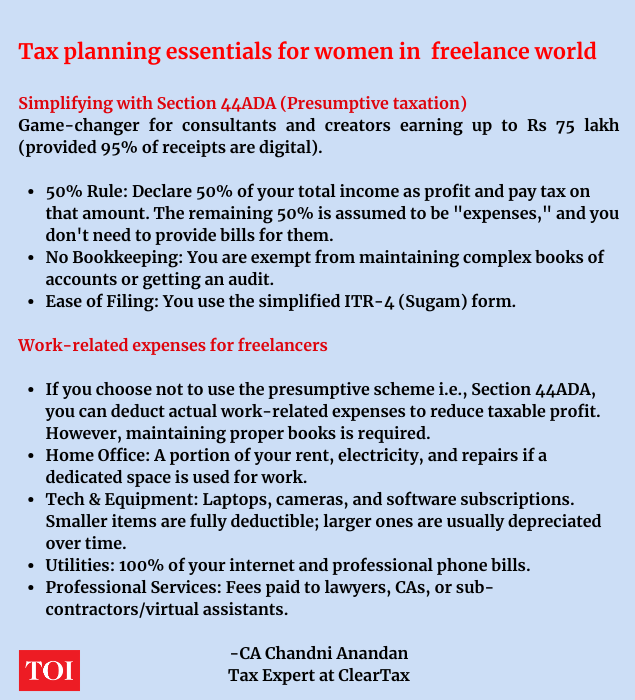
Anandan also detailed some common mistakes to be aware of for easy and accurate tax filing like being aware of last dates and the intricacies around availing the presumptive benefit or some deduction benefits women need to be aware about.

Meanwhile, among survey respondents, only a small proportion said they actively plan their taxes through the year, while the majority either plan occasionally or assess their tax liability only at the time of filing returns.This pattern is visible across responses. This pattern is visible across responses. Prachi Kumari, a PR professional in her 20s, and Anjali Yadav, a communication specialist in her 20s, both of whom manage their investments independently, were among those who said they assess taxes only at the time of ITR filing.Even among those who engage more actively, tax planning is often periodic rather than continuous. Several respondents (out of 30) said they plan “sometimes”, while a smaller segment reported planning annually with a clearer view of potential liabilities.For many salaried individuals, tax-saving remains limited to standard deductions or last-minute investments, rather than a structured, year-round strategy. Experts noted that this can lead to missed opportunities for optimising returns and building long-term wealth.
Why the gap persists
Despite higher participation, several structural and behavioural factors continue to shape outcomes:
- Limited early exposure to financial decision-making: A key factor is limited early exposure to financial decision-making. Several respondents cited lack of financial knowledge as a primary barrier, often leading to reliance on family members or advisors. One respondent (talking anonymously) said she has “grown accustomed to relying on my dad” for financial decisions, reflecting how these patterns can carry across generations.
- Household dynamics: Household dynamics also continue to play a role. While many women said they actively contribute to discussions, decision-making is still, in some cases, delegated. For instance, a professor in her 50s, speaking anonymously, said she relies on family or advisors for managing investments and assesses taxes only at the time of filing, reflecting a broader trend of partial involvement rather than full ownership.
- Time constraints and competing priorities: Respondents across age groups pointed to busy work schedules, caregiving responsibilities and limited bandwidth as reasons for not managing investments or tax planning more proactively. Behavioural factors such as fear of risk and limited disposable income also emerged strongly. Several participants said concerns about potential losses or insufficient funds hold them back from exploring market-linked instruments or more sophisticated strategies.
- Treating tax planning as compliance rather than strategy: Tax planning itself is often viewed as a compliance exercise rather than a strategic tool. Many respondents admitted to assessing taxes only at the time of filing or “sometimes” during the year, reinforcing the tendency to approach it reactively rather than as part of long-term financial planning.
Together, these factors contribute to a situation where women are getting increasingly involved in investing, but not always driving every aspect of financial planning.
A gradual shift towards ownership
There are, however, clear signs of change.Younger women and first-time investors are showing greater comfort with digital platforms, systematic investment plans (SIPs) and goal-based investing. Access to information and ease of execution are helping bridge some of the earlier gaps.The survey also suggests that many women are seeking advice actively rather than passively following it, indicating a shift towards more informed participation.“Young women in the workforce are thinking about money differently. Not just saving it. Actually putting it somewhere. Mutual funds, equities, Section 80C, NPS, these conversations aren’t limited to finance-bro circles anymore. They’re happening in group chats and comment sections,” said one of the respondents, Vishakha Nehe, founder of an influencer marketing platform.“Tax planning has shifted too. It used to be a February panic. Now more women are building their investment decisions around annual tax liability from the start, not scrambling when ITR season hits, she added.
From participation to control
The broader trend is evident as women are becoming a more visible and active part of India’s investment landscape. But the transition from participation to full financial control, particularly in tax planning, remains incomplete.As incomes rise and financial products become more accessible, the next phase of this shift will depend on how far participation translates into independent, informed decision-making.