

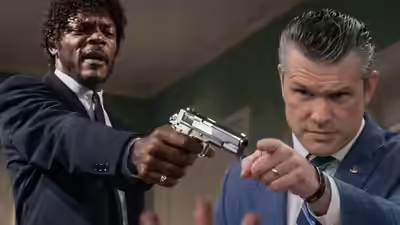
There are movies that become such cultural icons that they reverberate through the ages. Quentin Tarantino’s Pulp Fiction is one of them, leaving a cultural imprint so big that you can just quote the movie’s lines without context. And the most popular meme from that, which any fan can quote out of memory, is Ezekiel 25:17: a monologue that sounds Biblical, feels Biblical, and for decades has been treated as Biblical.Except, it isn’t.The real verse is austere, almost indifferent, a line about vengeance stripped of poetry and theatre. What Tarantino did was clothe it in grandeur, giving it rhythm, morality and the illusion of ancient wisdom. He turned a sentence into a sermon, and in doing so created something far more memorable than the original. That is the version most people recognise. It is also, in a slightly altered form, what surfaced this week inside the Pentagon.
The Big Picture
At a Pentagon worship service, US Secretary of War Pete Hegseth recited what he called “CSAR 25:17,” presenting it as a military prayer tied to combat search-and-rescue missions. He suggested it was meant to reflect Ezekiel 25:17, which is where the confusion begins.What he delivered was neither the Biblical verse nor Tarantino’s monologue in its original form. It was a third version, a military adaptation that borrows its structure and emotional force from the film while anchoring itself in scripture for legitimacy. Tarantino himself had performed a similar act of expansion, taking a sparse Biblical line and transforming it into a cinematic sermon. Hegseth’s version repeats that process within a different context, replacing theology with operational language.The “righteous man” becomes a “downed aviator,” “charity and goodwill” turn into “comradery and duty,” and the closing invocation of divine authority is recast as a callsign, “you will know my call sign is Sandy One.” The wording changes, but the architecture remains unmistakable, with its rising cadence, moral framing and climactic declaration of vengeance.
Driving the news
The setting gives the moment its weight. This was not an offhand remark but a worship service inside the Pentagon, livestreamed and presented as part of an institutional practice.Hegseth introduced the prayer as something used by “Sandy 1” to address A-10 crews before combat search-and-rescue missions, including a recent operation involving downed US personnel over Iran. He described it as commonplace in military settings, which suggests that the line has already been absorbed into a specific strand of military culture where repetition has granted it the feel of tradition.Viewers watching the service recognised the familiar cadence immediately, and the clip spread online, prompting questions about whether a Hollywood monologue had been repurposed as a prayer. The reaction also revealed a gap between those encountering the words as pop culture and those encountering them as institutional language.
Why it matters
The instinctive reading is to treat this as a misquote or a moment of confusion, but that misses what is actually happening. This is not a simple case of someone mistaking Tarantino for the Bible. It is an example of how language accumulates layers over time.The Biblical verse provides authority, the cinematic version provides drama, and the military adaptation provides context. Together, they produce something that feels coherent and convincing, even if it is not textually faithful to any one source.
That is why the question of whether Hegseth knew what he was quoting does not have a dramatic answer. There is no clear evidence that he consciously referenced Pulp Fiction. He presented the line as something rooted in Ezekiel and embedded in military practice, which suggests that the distinction between scripture, cinema and adaptation has effectively dissolved in this context. The line functions as a prayer because it sounds like one and because it has been repeated often enough to acquire authority.
Meme Lovers
There is also a broader pattern that explains why this moment feels entirely at home in Trump-era politics. This is a political ecosystem that treats culture as a usable vocabulary, where cinema, television and meme language are routinely drawn upon to frame ideas and communicate meaning. Authority is often borrowed from familiarity rather than from original source material.Pulp Fiction fits neatly into that framework because its most famous monologue already carries the cadence of scripture and the clarity of a moral fable. It offers a ready-made structure through which violence, righteousness and purpose can be articulated in a way that feels both dramatic and definitive.Hegseth’s “CSAR 25:17” sits at the intersection of these influences, combining elements of scripture, cinema and military tradition into a single piece of language that feels complete in the moment it is delivered.The discomfort it generates comes from recognising that the line does not need to be identified as a film reference to be effective. It has moved beyond that stage and now operates as something that sounds authoritative, carries moral weight and fits the occasion, even if its origins are far more complicated than they appear.