

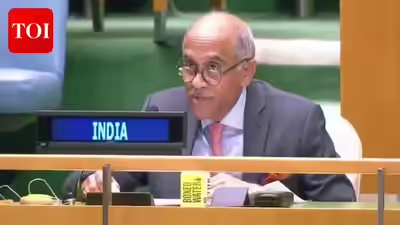
India on Monday strongly called out Pakistan at the United Nations for what it described as the habitual “fabrication” of Islamophobia narratives against neighbouring countries, while questioning Islamabad’s own record on the treatment of minorities and its actions against Afghanistan during Ramzan.At the UN General Assembly’s commemoration of the International Day to Combat Islamophobia, India’s Permanent Representative to the UN, ambassador Parvathaneni Harish, delivered a sharp rebuttal aimed at Pakistan and the Organisation of Islamic Cooperation (OIC), while also urging the UN to avoid frameworks that focus on only one faith rather than tackling all forms of religious discrimination.
‘India’s western neighbour’ fabricates Islamophobia tales
Harish said, “India’s western neighbour is an excellent example of fabricating imaginative tales of Islamophobia in their neighbourhood.”In a pointed attack, he added: “One wonders what would brutal repression of Ahmadiyyas in this country be termed, or the large-scale refoulement of the helpless Afghans or air-bombing campaigns in this Holy Month of Ramadan?”Harish was responding in the context of recurring attempts by Pakistan to raise allegations against India at multilateral forums under the banner of Islamophobia.He also said that the OIC, which “our western neighbour has systematically attempted to weaponise against India”, has repeatedly made “false and baseless allegations” against the country.
India warns against weaponising religion at UN
Harish stressed that the UN must take note of the “rising trend and dangers of weaponising religious identity and instrumentalising it to serve narrow political ends by state and non-state actors alike.”According to news agency PTI, he cautioned that the politicisation of religion does not solve grievances and instead risks legitimising “selective, polarising narratives” that deepen divisions.“The United Nations was conceived as an institution that transcends religion, culture, and politics. Its credibility rests on universality and impartiality,” he said.He further urged “caution against frameworks that exclusively focus on one faith, without addressing the broader phenomenon of religiophobia in all its manifestations.”India also underlined that the 1981 Declaration on the Elimination of All Forms of Intolerance and of Discrimination Based on Religion or Belief remains a balanced and enduring instrument because it protects followers of all faiths without privileging any one religion.
India highlights its Muslim population, Kashmir eepresentation
Emphasising India’s plural character, Harish said India is home to more than 200 million Muslims, one of the largest Muslim populations in the world.He said Muslims in India, including those in Jammu and Kashmir, elect their own representatives to speak for them.“The only ‘phobia’ evident here appears to be directed against the multicultural and peaceful coexistence that all communities in India enjoy, including Muslim communities,” he said.He added that such narratives run contrary to India’s “fundamental ethos” and instead reflect “the sectarianism and terrorist mentality that this country has perpetuated since its inception.”
Afghanistan reference adds sharp edge
Harish’s mention of “air-bombing campaigns in this holy month of Ramadan” came amid escalating tensions between Pakistan and Afghanistan.Afghanistan has alleged that around 400 people were killed and about 250 injured in an airstrike on the Omid Addiction Treatment Hospital in Kabul on Monday night, with Taliban spokespersons blaming Pakistan. However, Pakistani media outlet Samaa, citing security sources, rejected the allegation and termed the claim that a drug treatment hospital was struck as “ridiculous”.Pakistani authorities have maintained that the strikes targeted Taliban-linked military infrastructure in Kabul and Nangarhar and were carried out with “no collateral damage”.