


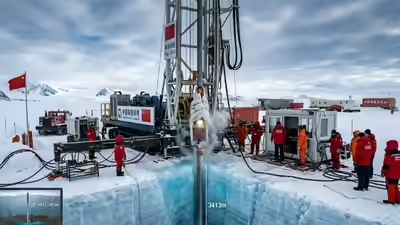
China has achieved a major milestone in polar exploration, successfully drilling through 3,413 meters of Antarctic ice to reach the area above the Qilin Subglacial Lake. Conducted by the 42nd Antarctic expedition team on February 5, 2026, this feat surpasses the previous global record for hot-water drilling by nearly 900 meters, as noted in the State Council Information Office (SCIO) of the People’s Republic of China. By utilising a cutting-edge, domestically developed hot-water system, researchers have established a contamination-free pathway into one of the most isolated environments on Earth. This breakthrough not only highlights China’s advanced technical capabilities in extreme polar conditions but also opens new doors for studying paleoenvironmental shifts, ancient biological evolution, and the fundamental dynamics of the Earth’s ice sheets.
China broke the global drilling record by drilling 3,413 meters
The 3,413-meter achievement officially eclipses the previous international benchmark of 2,540 meters. This leap in depth enables Chinese researchers to conduct drilling operations across more than 90 per cent of the Antarctic ice sheet and the entirety of the Arctic ice cover, as mentioned in SCIO. The mission was successfully executed in East Antarctica’s Princess Elizabeth Land, approximately 120 kilometres from China’s Taishan Station.
How modern drilling reaches the subsurface
Unlike traditional mechanical drilling, which utilises rotating metal bits that can cause contamination or mechanical failure in deep, frigid environments, hot-water drilling uses high-pressure, near-boiling water to melt a clean, stable borehole. This method is now the international gold standard for accessing subglacial lakes because it minimises disturbance to the surrounding ice and prevents the introduction of foreign microbes, making it safer for collecting pristine water and sediment samples. This initiative is very well conducted by the team archery.
A pristine time capsule beneath the Antarctic ice
As noted in China Daily, Qilin Subglacial Lake, independently named by China in 2022, serves as a natural time capsule. Having been sealed under kilometres of ice for millions of years, the lake exists in a state of high pressure, total darkness, and extreme isolation. Scientists believe that studying the lake’s microbial communities and biogeochemical cycles is vital for understanding Earth’s long-term climate evolution and providing analogues for potential life on icy moons, such as Europa or Enceladus.