

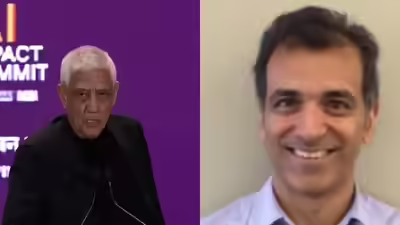
TOI correspondent from Washington: If the dotcom era gave investors dreams of effortless millions and the crypto boom offered visions of digital billions, the coming IPOs of SpaceX and OpenAI – likely in June and September respectively – promise something more intoxicating: trillion-dollar fantasies wrapped in Silicon Valley superlatives. One company wants to take humanity to Mars. The other wants to automate humanity before it gets there. Together, the two offerings — one built on rockets and satellites, the other on artificial intelligence capable of writing poetry, software code and occasionally your boss’s PowerPoint presentation — are shaping up as the biggest technology spectacles since the internet boom of the early 2000s.And quietly preparing for astonishing windfalls from the two IPOs are two Indian-origin investors who placed early bets before the rest of Wall Street began attaching a dozen zeroes to valuations.The better-known of the two is veteran Silicon Valley venture capitalist Vinod Khosla, whose Khosla Ventures became one of OpenAI’s earliest major backers in 2019 when he wrote a $ 50 million check shortly after Sam Altman approached him when co-founder Elon Musk backed away from his initial funding commitments. The storied investor later admitted it was the riskiest bet of his career, saying he apologised to his own investors before making the commitment.That gamble is now close to a big windfall. If OpenAI eventually lists at the $850 billion-to-$1 trillion valuation range now being whispered across Wall Street, Khosla’s investment could now be worth around $1.5 billion, a return of 30 times the original investment, making it one of the most profitable venture capital bets in modern tech history.The story carries a particularly painful footnote for India Inc. Bengaluru-based Infosys was, in fact, among the original co-founding supporters of OpenAI when it was launched as a non-profit research lab in December 2015, contributing $3 million as a philanthropic donation. Then CEO Vishal Sikka reportedly pushed for a far larger strategic investment of up to $1 billion, but conservative voices on the Infosys board blocked it, questioning whether such a dramatic departure from the company’s traditional IT services business model was prudent. Had Infosys proceeded with the investment, the resulting stake today could have been worth roughly $45 billion — nearly 90 percent of Infosys’s current market capitalisation.If Khosla’s OpenAI investment now appears visionary, Anand Desai’s New York-based hedge fund Darsana Capital Partners’ bet on SpaceX increasingly resembles buying Manhattan before the Dutch arrived. Desai became a “Musk-ateer” in 2019, accumulating shares when SpaceX carried a valuation of roughly $30-33 billion. At that time, Musk’s talk of Mars colonies still sounded like science fiction rather than a future business plan. Appropriately now for a hedge fund named after the Sanskrit word “darsana,” meaning spiritual insight or divine revelation, the firm appears poised to make an almost mythic fortune from an investment many initially viewed as detached from commercial reality. Today, SpaceX is reportedly targeting a valuation between $1.5 trillion and $1.75 trillion for its public listing. According to The Wall Street Journal, nearly 60 percent of Darsana’s assets are tied to SpaceX shares, and the fund’s stake could now be worth more than $10 billion.Both the Desai and Khosla bonanzas are small beer compared to what Musk himself is poised to reap. His estimated 85 percent ownership of SpaceX would make him the world’s first trillionaire, placing him in financial territory previously occupied only by oil-rich kingdoms and central banks.——-Behind the looming IPOs lies a rivalry almost as compelling as the valuations themselves. The increasingly bitter feud between Musk and Altman has become the defining corporate soap opera of the AI age. Musk co-founded OpenAI with Altman in 2015, presenting it as a non-profit initiative aimed at ensuring artificial intelligence benefited humanity. But disagreements over control, direction and funding eventually drove Musk out.Khosla has publicly alleged that Musk wanted OpenAI to become his “private fiefdom,” while Altman instead pursued alternative funding structures and governance arrangements. Since then, the two men have traded sharp public and private barbs while racing to dominate the future of artificial intelligence. Altman promotes AI as humanity’s inevitable operating system. Musk warns that AI could destroy civilisation — while simultaneously building his own competing AI company, xAI. It is, as one Silicon Valley wag joked, rather like two arsonists arguing over fire safety regulations. Yet investors appear largely unconcerned by either the rivalry or the risks. Both companies now occupy that rarefied zone in modern finance where conventional accounting matters less than narrative, ambition and hype. The frenzy surrounding the IPOs reflects a belief that these are not merely corporate listings but civilisational milestones. One company promises to replace large parts of human labour. The other promises to take humans into space. Whether either can ultimately justify trillion-dollar valuations remains uncertain. But for Anand Desai and Vinod Khosla, the arithmetic already looks heavenly. In Silicon Valley, prophets are not always right, but the earliest believers usually become spectacularly rich.
Khosla and Desai come to the Musk-Altman party
 PM Narendra Modi gifts traditional Eri silk stole for Giorgia Meloni: Know its history and cultural importance