

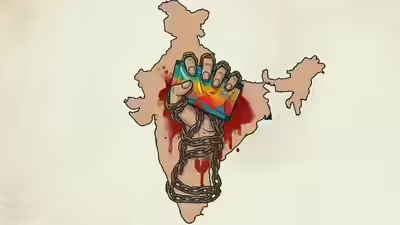
None of us are strangers to the fact that nicotine is bad. In India you cannot even go to the movies without a tobacco awareness ad playing. Your cigarette boxes and tobacco sachets have the most horrifying graphics meant to dissuade you from buying them. But you still do.The cycle of addiction has never been something you can be horrified out of.Add to this how surface level these attempts are when you compare the reverberated ad of the man coughing on his deathbed to the most stylised character in films and shows casually smoking a cigarette. You start a movie knowing smoking kills. You spend the next two hours watching it not kill — instead, watching it make someone look “hot” or “powerful.” The biggest names of our entertainment industry are quick to sign off their image to tobacco brand deals, almost equating it to a luxurious lifestyle.One message plays before the film. The other is the film itself.It is an extreme virtue signalling now to tell people to quit tobacco in a country where more than 2 out of 10 people have a reliance on it. And an issue more unique to the South Asian subcontinent is one of smokeless tobacco.There are about 20 crore Indians who use smokeless tobacco every day. Smokeless tobacco comes in small plastic pouches sold for a few rupees at every corner shop. Gutkha. Khaini. Zarda. It sits quietly on the shelf next to biscuits and candies. One of the most cancerous products to ever be available for retail can be purchased for 2 rupees. Dr. Madhurima Nundy, Academic Research Associate at the University of Edinburgh, explains that “more than 28 types of carcinogens have been extracted from these products.“India is home to over 80% of the world’s smokeless tobacco users. This is not a global problem. This is our problem. And yet, while cigarette packets carry graphic warnings and face high taxes, smokeless tobacco remains cheap, widely available, and under-regulated.While the rest of the world battles with vapes creating a new market for younger tobacco users, something that at least legally India has covered. The biggest concern for our country remains the countless people “painting it red” every single day.
–
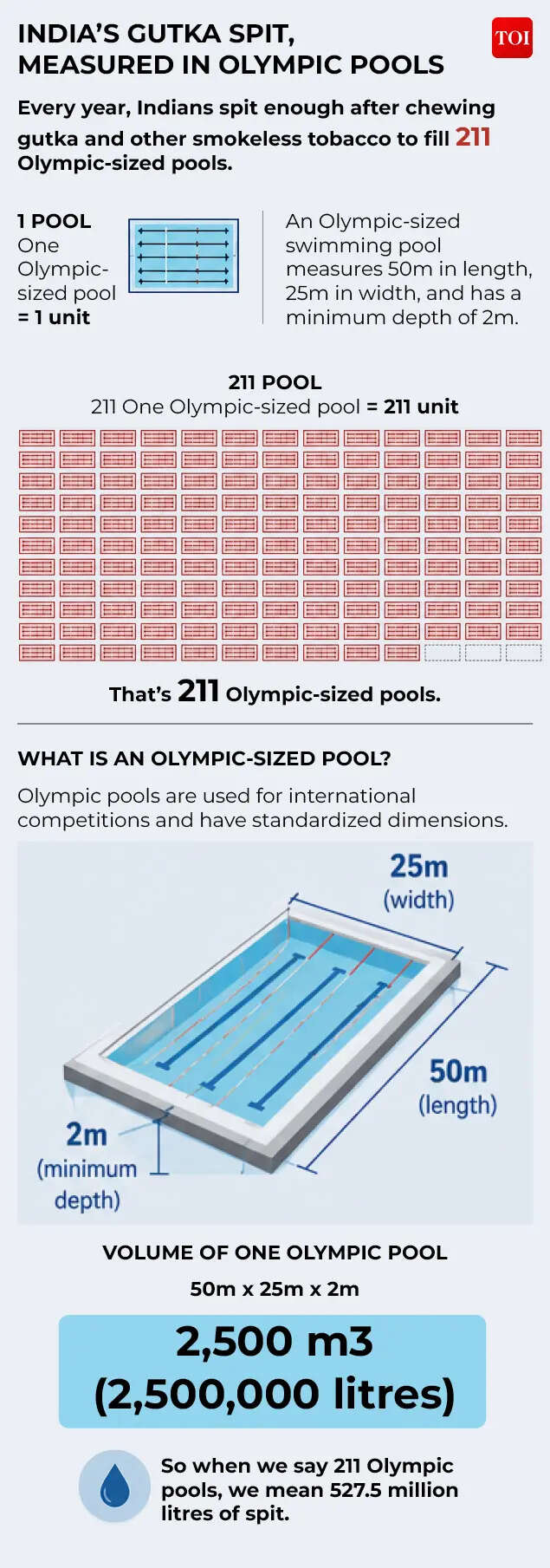
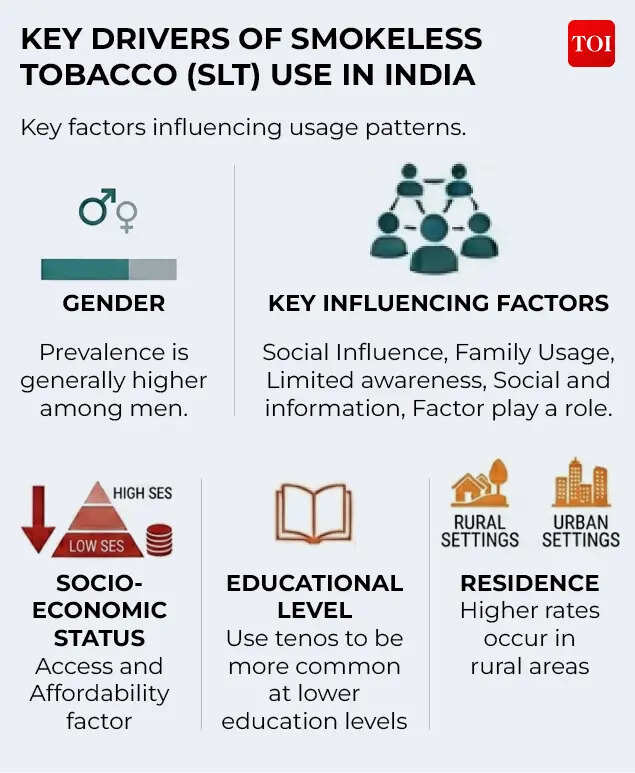
Enough to fill 211 Olympic-sized pools every year. That is how much Indians spit after chewing gutka and other smokeless tobacco. The Indian Railways spends about ₹1,200 crore annually just to clean these stains off trains and stations. The Howrah bridge pillars have started corroding because of it.But the problem did not start yesterday.Tobacco cultivation in India began in 1605. The Portuguese introduced it in the Kaira and Mehsana districts of Gujarat. What started as a colonial crop became a cultural fixture. Over centuries, it embedded itself into daily life, the paan after a meal, the tobacco shared among labourers, the quiet addiction that asked for very little money and gave back a brief escape.Then came gutka. A man named Mansukhbhai Kothari from Gujarat figured out how to powder the paan and sell it in small, cheap packets. Five rupees. Two rupees. Sometimes less. It was affordable in a way that cigarettes never were. And it hit instantly. Gutka delivers nicotine to the bloodstream faster than cigarettes. It is about three times more addictive. Even the process behind consumption is more instantaneous than a smoke break.Which brings us to the sociological divide. Smoking and smokeless tobacco use in India are not the same problem. They do not affect the same people in the same way.Cigarette smoking in India is concentrated among wealthier, urban populations. A survey by the International Institute for Population Sciences found that daily smokers are wealthier and more educated than non-smokers. The poorest households have the lowest rates of smoking. There is no mystery to this, cigarettes are expensive. They are heavily taxed. A single packet costs what a labourer might earn in a day.Smokeless tobacco is the opposite. It is cheap, and easily accessible. According to Dr. Nundy, the main determinants of SLT use in India are clear: “gender (males more than females), educational level (illiterate more than literate), urban-rural residence (rural more than urban), socio-economic status (low more than high), and low tax on SLT products.” She adds that “peer pressure, parental usage and limited knowledge about the harmful effects” are also major factors.
–
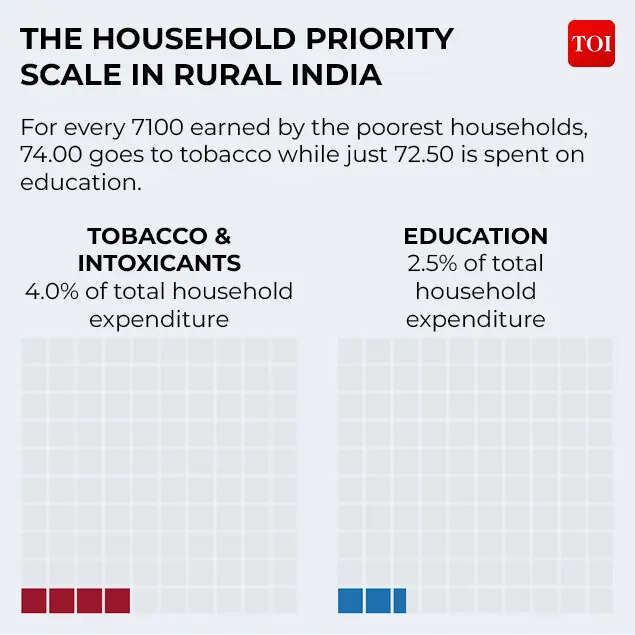
For a daily wage labourer exhausted after a brutal day of physical work, a ₹2 packet of gutka is the most affordable escape. It acts as a hunger suppressant when there is no money for a meal. Nicotine releases dopamine and makes you feel full. This why even children beggars in India prefer petty change over a packet of biscuit. The petty change lets them consume gutka and keep themselves fuller and in doped state for longer than a biscuit could ever.A poor child who begs in the area next to Nehru Place metro station said. “Biscuit se pet nahi bharta. Gutkha se bhook thoda kam lagta hai. Aapko paisa dena hai toh do ye baaki ke cheeze nahi chahiye” (Biscuits do not fill my stomach, smokeless tobacco helps me not feel hungry. If you want to give me money give it or else do not give me anything)The poorest households in rural India spend about 4% of their total expenditure on tobacco and intoxicants. They spend only 2.5% on education. Every year, an estimated 1.84 crore Indians are pushed into extreme poverty by tobacco-related illness and death. They lose not just their savings but their primary breadwinner. The family stays poor.
–
The tobacco industry is not why poverty exists in India, but it does profit off it.The Indian culture of ‘jugaad’ has proliferated more levels than it should in relation to the smokeless tobacco epidemic. An auto driver near Hauz Khas commented on the abuse of these narcotics by young kids stating that, “You can make as many laws as you want. But there is always a jugaad (loophole)” He went on to put blame for the abuse of SLT not only on the system but also on the parents. He said that addiction makes you blissful enough to forget hardships and that is why a lot of children born into poverty are introduced to these narcotics very early on by their parents.A call for a total ban at this stage is impractical, we have seen how functional that has been with vapes. When you ban something you instantly create a profitable black market for it. The best way to move forward is to make the product less accessible, less appealing and less affordable.The gutka ban of 2011 was a good intention that became a case study in failure. Manufacturers did not stop selling their products. They simply split the contents into two separate pouches — tobacco in one, flavouring in another — sold side by side. The customer buys both and mixes them at home. Technically, no law is violated because neither pouch alone contains the banned combination. This is jugaad at an industrial scale, and it has made a mockery of the ban.Close this loophole. If a product is consumed as gutka, it should be regulated as gutka. Separate pouches that are sold together and intended to be mixed should be treated as a single product under the law.Then fix the packaging. The plastic ban came in 2011 when the Supreme Court prohibited plastic sachets for gutka, tobacco, and pan masala. Walk into any corner shop today and you will still find them in plastic. Enforce the ban. Fine the manufacturers. Seize the products. Make compliance visible. A law that is not enforced is not a law at all. It is just a suggestion.Next, look at the price. A Rs 2 packet of gutka is not a product. It is a trap. Children can afford it. Daily wage labourers buy it instead of food. Set a minimum pack size and make the cheapest legal pack cost at least Rs 20 or Rs 30. The poor will not stop using tobacco overnight, but some will. And many children will never start.Then control who can sell it. Anyone can sell tobacco in India today. No license is required, no training is mandatory, and there are no consequences for violations. Require a retail license. Revoke it for selling to minors or for violating packaging laws. Himachal Pradesh has already done this. Punjab and Patna are moving in that direction. The rest of the country can follow.Raise the legal age. Eighteen is the current minimum age to buy tobacco in India, but it is not enforced. Raise it to 21. Sri Lanka has done it, and seven other countries have followed. Research shows that delaying the age of first use dramatically reduces the likelihood of lifetime addiction.Increase taxes. The WHO recommends that taxes make up at least 75% of the retail price of tobacco products. India is nowhere near that for smokeless tobacco. Cigarettes are taxed heavily, but smokeless tobacco is not. This is not an accident. It is a policy choice that prioritises revenue over public health. Higher prices reduce consumption, and a 10% price increase leads to an 11% drop in demand among lower-income households. These are the people who need protection the most.Dr. Nundy argues that “there exists an urgent need to address these determinants with stricter government policies on taxation and tobacco control. Mass media campaigns directed more at the predisposed population and clear risk labelling of products could go a long way in reducing usage.”The child near Nehru Place metro station does not need another awareness ad. He has seen the graphic on the sachet and knows it is bad for him. He buys it anyway because two rupees is cheaper than a meal. Until the government makes smokeless tobacco unaffordable, unavailable, or unappealing, he will keep buying it. The industry will keep selling it. The railways will keep cleaning it. And 1.84 crore Indians will keep falling into poverty every year.