


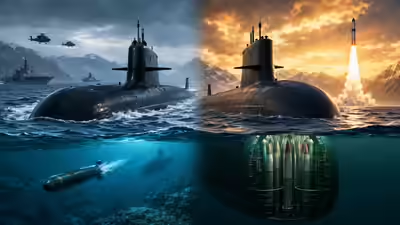
NEW DELHI: Submarines powered by nuclear reactors are often grouped together as “nuclear submarines”, but there are two very different categories: SSNs (nuclear-powered attack submarines) and SSBNs (nuclear-powered ballistic missile submarines). Both use nuclear reactors for propulsion, allowing them to remain underwater for months, but their missions, weapons and strategic roles are fundamentally different.For India, understanding this distinction is crucial because the country already operates SSBNs as part of its nuclear deterrent, while it is only now moving towards building a sizeable fleet of SSNs.
The alphabet soup of nuclear submarines
The designation system originates from the US Navy. The first “S” stands for submarine. The second “S” indicates nuclear propulsion. The final letter defines the submarine’s primary role.An SSN is a nuclear-powered attack submarine. Its primary mission is hunting enemy submarines and warships, gathering intelligence, escorting carrier groups and conducting conventional strike missions. An SSBN, meanwhile, is a nuclear-powered ballistic missile submarine designed primarily to carry nuclear-tipped ballistic missiles and provide a country’s second-strike nuclear capability.Although both use nuclear reactors and can remain submerged for extended periods, they are built for entirely different strategic purposes. One fights wars; the other is designed to prevent them.
What exactly is an SSN?
An SSN is essentially a stealth hunter. It is among the most versatile naval platforms ever built.Attack submarines are designed to track and destroy enemy submarines, sink surface ships, gather intelligence, monitor sea lanes and, in some cases, launch cruise missiles against land targets. Because they are powered by nuclear reactors, they do not need to surface frequently for fuel, allowing them to operate across vast oceanic distances.Modern SSNs are equipped with torpedoes, anti-ship missiles, land-attack cruise missiles and advanced sonar systems. They are usually faster and more manoeuvrable than ballistic missile submarines because speed and stealth are critical to their missions.The world’s leading SSN operators include the United States, Russia, the United Kingdom, France and China. Their attack submarines routinely shadow adversary fleets, monitor chokepoints and conduct covert surveillance operations.
What exactly is an SSBN?
An SSBN serves a very different purpose. Rather than hunting enemy vessels, its primary mission is strategic nuclear deterrence.These submarines carry submarine-launched ballistic missiles (SLBMs), many of which can be armed with nuclear warheads. During a conflict, they remain hidden in vast ocean areas, making them extremely difficult to detect and destroy.The logic behind SSBNs is straightforward. Even if an adversary destroys a country’s land-based nuclear missiles and air bases in a surprise attack, hidden SSBNs can survive and retaliate. This guaranteed ability to respond is known as a second-strike capability.Because of this role, SSBNs are often described as the most survivable leg of a nation’s nuclear triad, which consists of land-based missiles, aircraft-delivered nuclear weapons and sea-based nuclear weapons.
Why SSBNs are considered the crown jewels of deterrence
The greatest challenge in nuclear strategy is ensuring survivability. Fixed missile silos can be targeted. Aircraft require airfields. Ballistic missile submarines, however, can disappear into thousands of square kilometres of ocean.A single SSBN can remain submerged for months while carrying enough nuclear warheads to inflict devastating damage. For this reason, countries possessing SSBN fleets regard them as strategic assets of the highest national importance.The United States, Russia, China, Britain, France and India all maintain SSBN forces as part of their nuclear deterrence structures.
How SSNs and SSBNs differ in design
Although they may appear similar externally, the differences are substantial.SSBNs are generally larger because they must carry ballistic missiles housed in vertical launch tubes. Their focus is on stealth and endurance rather than agility. Their patrol routes are carefully protected because preserving their secrecy is vital.SSNs, by contrast, prioritise speed, manoeuvrability and combat flexibility. They carry torpedoes and cruise missiles rather than large ballistic missiles. Their missions frequently involve actively tracking enemy vessels and operating in contested waters.An SSN might spend months stalking an adversary’s submarine. An SSBN might spend the same period avoiding detection entirely.
What India has today
India currently operates a fleet of nuclear-powered ballistic missile submarines under the Arihant-class programme.The lead vessel, INS Arihant, entered service in 2016 and marked the completion of India’s nuclear triad. It was followed by INS Arighat, while additional boats are at various stages of development and construction.These submarines carry India’s indigenous K-series submarine-launched ballistic missiles, including the K-15 and longer-range K-4 systems. Their primary mission is strategic deterrence rather than conventional naval warfare.In short, India already possesses an operational SSBN capability.
What India does not yet have
India does not currently operate an indigenous fleet of nuclear-powered attack submarines.The Indian Navy has experience operating SSNs through leased Russian submarines. Most notably, INS Chakra provided valuable operational experience. However, leased platforms are not the same as maintaining a domestically built SSN force.India has approved plans to construct indigenous SSNs, with multiple boats expected under a long-term programme. These submarines are intended to operate across the Indian Ocean Region, monitor Chinese naval activity, protect carrier battle groups and escort Indian SSBNs during patrols.Until these submarines enter service, India remains one of the few major nuclear powers with an SSBN fleet but without an operational indigenous SSN force.
Why India needs SSNs even though it has SSBNs
The two submarine types complement each other.SSBNs provide nuclear deterrence, but they also require protection. Enemy attack submarines constantly seek to track ballistic missile submarines because locating them could undermine a country’s second-strike capability.This is where SSNs become essential. They escort SSBNs, hunt adversary submarines and secure maritime approaches. In many navies, attack submarines act as the shield protecting the strategic deterrent force.As China’s naval presence expands in the Indian Ocean and the People’s Liberation Army Navy increases deployments of both conventional and nuclear submarines, Indian planners increasingly view SSNs as necessary for maintaining undersea dominance.
The future of India’s undersea force
India’s long-term submarine strategy aims to field both strong SSBN and SSN fleets.The Arihant-class and its successors will continue to strengthen the sea-based nuclear deterrent. At the same time, the planned indigenous SSN programme seeks to provide the Indian Navy with a powerful conventional undersea warfare capability.The end goal is similar to that of the United States, Russia, China, Britain and France: a balanced nuclear submarine force in which SSBNs deter nuclear attack while SSNs control the underwater battlespace.An SSBN is a strategic nuclear deterrent platform whose main mission is carrying ballistic missiles and ensuring a second-strike capability. India already possesses this capability through the Arihant-class submarines.An SSN is a nuclear-powered attack submarine designed to hunt enemy vessels, gather intelligence and dominate the underwater domain. India has operated leased examples but has not yet fielded an indigenous operational SSN fleet.