

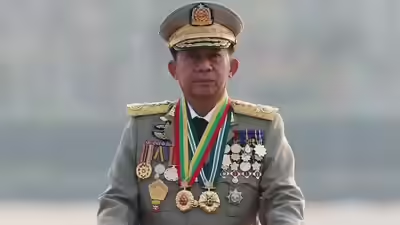
Min Aung Hlaing has been elected president of Myanmar after winning a parliamentary vote dominated by pro-military lawmakers, formalising his control over the country five years after leading a coup against an elected government.The 69-year-old general secured the presidency following a vote in a parliament largely controlled by the military-backed Union Solidarity and Development Party and appointed armed forces representatives.Min Aung Hlaing, who has led Myanmar’s armed forces since 2011, seized power in 2021 by overthrowing the civilian government of Aung San Suu Kyi, placing her under arrest and triggering nationwide protests that later evolved into an armed resistance movement.His elevation to the presidency follows elections held in December and January, which were won by an army-backed party. The polls were criticised by opposition groups and Western governments as lacking credibility and seen as a mechanism to extend military rule under a civilian framework.During a live broadcast of the vote count, Min Aung Hlaing comfortably crossed the threshold required to secure the presidency.His transition to the presidency came alongside a reshuffle in military leadership. Earlier this week, Min Aung Hlaing nominated Ye Win Oo, a former intelligence chief considered a close ally, as his successor to lead the armed forces.Analysts view the move as a strategic effort to consolidate authority while projecting the image of a civilian administration.“He has long harboured the ambition to trade his title of commander-in-chief for president and it appears his dreams are now becoming a reality,” said independent analyst Aung Kyaw Soe.The shift is also seen as an attempt to gain international legitimacy while maintaining the military’s influence over governance.Despite the leadership transition, Myanmar remains engulfed in conflict. Armed resistance groups, including factions linked to Suu Kyi’s party and ethnic minority forces, have intensified coordination against the military.“Our vision and strategic objectives are to completely dismantle all forms of dictatorship, including the military dictatorship, and to collectively initiate a new political landscape,” the Steering Council for the Emergence of a Federal Democratic Union said in a statement.Analysts warn that opposition groups may face increased military pressure under the new political arrangement, as well as changing dynamics with neighbouring countries.Experts say the evolving political and economic environment could further complicate resistance efforts.“Amidst global oil and fuel shortages and economic crises, maintaining organisational stability could become difficult,” analyst Sai Kyi Zin Soe said.“As these hardships grow, it may become even harder to build mutual understanding and trust between groups, reach firmer agreements, and sustain cooperation.”The development underscores the continuing instability in Myanmar, where the military’s consolidation of power is unfolding alongside an ongoing civil conflict with no immediate resolution in sight.
Myanmar army chief Min Aung Hlaing elected as President
 'You Know Nothing Of Our...': Iran Holding Back 50% Of Its Missiles, 1,000 Drones? Shocking Report