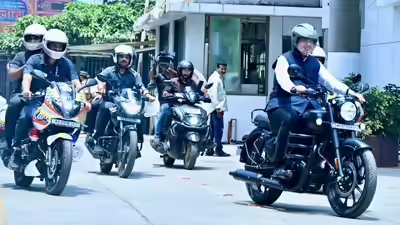


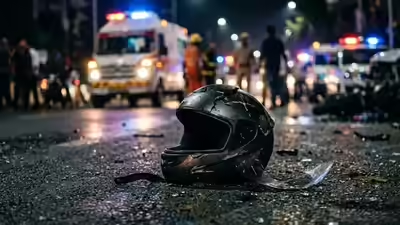
This article is authored by Rajeev Kapur, President, 2WHMA (Two-Wheeler Helmet Manufacturer Association India).In our country, most families have a simple habit. Before someone leaves home on a two-wheeler, there is always one reminder: “Helmet pehen lena.” That sentence comes from care. From fear. From hope that the person returns home safely. But what happens when the helmet itself cannot protect the rider? This is a reality India needs to talk about more seriously.For years, road safety discussions have mainly focused on traffic violations, speeding, penalties and road conditions. These are important issues, no doubt. But there is another problem quietly growing in markets across the country: fake helmets.A rider may feel safe wearing one. The family may feel relaxed seeing it. Even traffic enforcement may assume the rider is protected. But many helmets being sold today are made only to look genuine. During an accident, they crack instantly or fail to absorb impact properly. And the rider suffers the consequences. The sad part is that most people buying these helmets do not even know they are fake.In local markets and roadside shops, helmets are available at prices so low that people naturally get attracted. Many buyers are daily wage earners, students or delivery riders trying to manage monthly expenses. They are not checking technical specifications. They simply believe that if a helmet has a BIS mark, it must be safe. Unfortunately, even such indications are now being imitated by fake goods. The situation is dangerous because of this.In India, a considerable number of two-wheeler riders lose their lives in traffic incidents each year. Every number has a real-life backstory, such as a family losing a son, a child losing a father, or parents losing a child they raised with aspirations and sacrifices.When safety equipment itself becomes unreliable, the entire purpose of road safety weakens. The issue is not only about people wearing helmets anymore. The issue is whether the helmet can actually save a life during those few critical seconds after impact.As someone connected with the helmet industry for many years, I strongly believe action must begin from the manufacturing level. Fake helmets should never reach the consumer in the first place.No matter how many awareness efforts are conducted, illegal manufacturing facilities that produce counterfeit helmets are functioning openly in some locations and providing goods throughout markets. Until these networks are strictly prosecuted, fake helmets will continue to proliferate everywhere. No matter how many awareness programs are conducted, phony helmets will continue to proliferate worldwide unless severe action is done against these networks.This is not just about business losses or duplicate products. This is directly connected to public safety. There is also another important issue we rarely discuss. After serious road accidents, investigations usually focus on the vehicle, speed or road condition. Hardly anyone checks whether the helmet used was genuine or fake. That should change.If authorities begin examining BIS licence details of helmets involved in fatal accidents, it will become easier to identify counterfeit products and understand how deeply fake helmets are affecting road safety in India. The proposal of providing two BIS-certified helmets with every motorcycle sale is also a positive step. It can help genuine helmets reach consumers directly through authorised channels instead of unsafe roadside markets.At the same time, awareness must continue at every level. People should understand that a cheap helmet can become the costliest mistake of their life. Road safety is not only the responsibility of traffic police or manufacturers. It is a shared responsibility.A rider trusts a helmet during the worst possible moment of life: an accident. That trust should never be broken. Because when a helmet fails, it is not the product alone that breaks. Sometimes, an entire family breaks with it.Disclaimer: Views and opinions expressed in this article are solely those of the original author and do not represent any of The Times Group or its employees.
The helmet on your head should save your life, not risk it
 How to grow jasmine that flowers year-round in Indian weather: 5 mindful tips for beginners