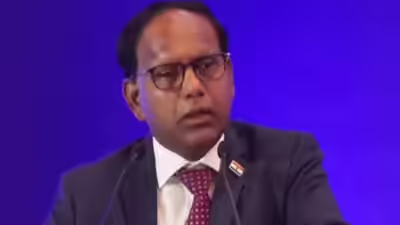


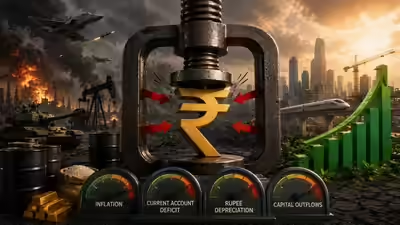
India appears to be facing one of its toughest economic challenges in recent years. Oil, gold, fertiliser and other commodity prices are elevated. The foreign portfolio investors are continuing to sell. Imports remain unabated. Exports are facing headwinds. Remittances from the Middle East may be impacted. And all these channels are feeding into the economy with a depreciating rupee adding to the woes.It’s no wonder then that the present situation and its impact has been called a “live balance of payments stress test” by the chief economic advisor V Anantha Nageswaran. The CEA’s words could not be more direct and the situation the world’s sixth largest economy faces is by no means small. Several macroeconomic indicators are in focus; inflation, health of the current account, and the exchange rate.Why is it a stress test? Because several stress factors have been activated simultaneously. India is dependent on the Middle East for a large percentage of its energy imports. India imports fertilisers and fertiliser feedstock gas from the region and hence is dependent on this geography for the same. A large diaspora in the Middle East that generates employment also leads to significant remittances. The Middle East is also one of our biggest export destinations. What is balance of payments? Why is it important as an indicator of a country’s external sector health? What’s the outlook and is a structural problem looming?
Understanding what is Balance of Payments & its importance
Every country keeps a detailed record of its financial transactions with the rest of the world. This record is known as the Balance of Payments, or BoP. It is one of the most important indicators of a country’s economic health because it reflects how much foreign exchange is coming into the country and how much is going out.
In simple terms, whenever foreign currency enters India through exports, investments, remittances or foreign loans, it is recorded as an inflow. Whenever dollars leave India to pay for imports, overseas travel, investments abroad or debt repayments, it is treated as an outflow. If inflows exceed outflows, the country records a Balance of Payments surplus. If outflows are higher than inflows, it results in a Balance of Payments deficit.
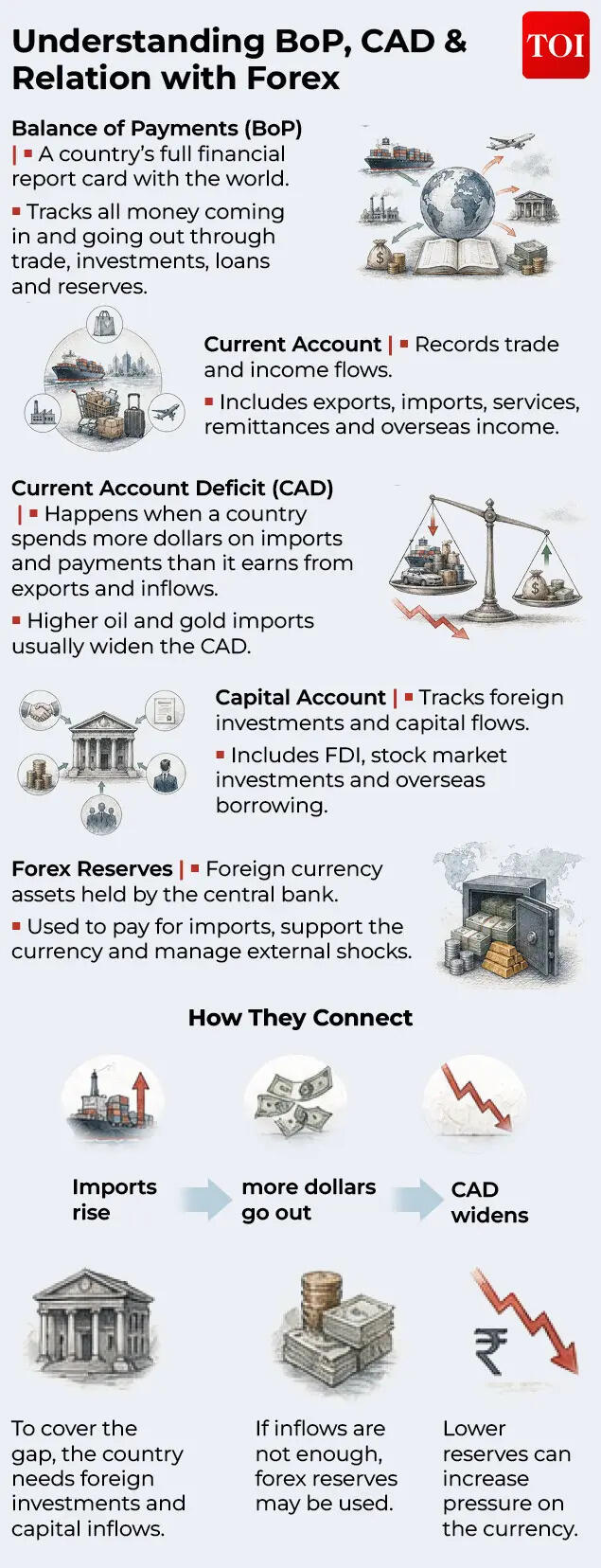
So why does BoP matter? The Balance of Payments directly affects a country’s currency, foreign exchange reserves, inflation and economic stability.For a country like India, which imports nearly 90% of its crude oil requirement and around 50% of its gas needs, managing foreign exchange becomes critical. India needs dollars to buy oil, gold, electronics, fertilisers and edible oils from global markets.If the demand for dollars rises sharply, the rupee weakens because more domestic currency is needed to buy the same amount of foreign exchange. A weaker rupee then makes imports even more expensive, adding to inflationary pressure.This is why economists are closely tracking India’s BoP position. According to a recent JPMorgan report led by economist Sajjid Chinoy, capital flows into India have slowed sharply in recent years. Net capital inflows averaged 2.6% of GDP between 2015 and 2019, but fell to 1.4% in 2024 and nearly disappeared in 2025.The slowdown has been largely driven by falling foreign direct investment and sustained selling by foreign portfolio investors.
Why is India’s BoP under pressure & why is it a ‘live stress test’?
India’s external sector is currently facing pressure from multiple fronts. Rising geopolitical tensions involving Iran and disruptions around the Strait of Hormuz have pushed up global crude oil prices.
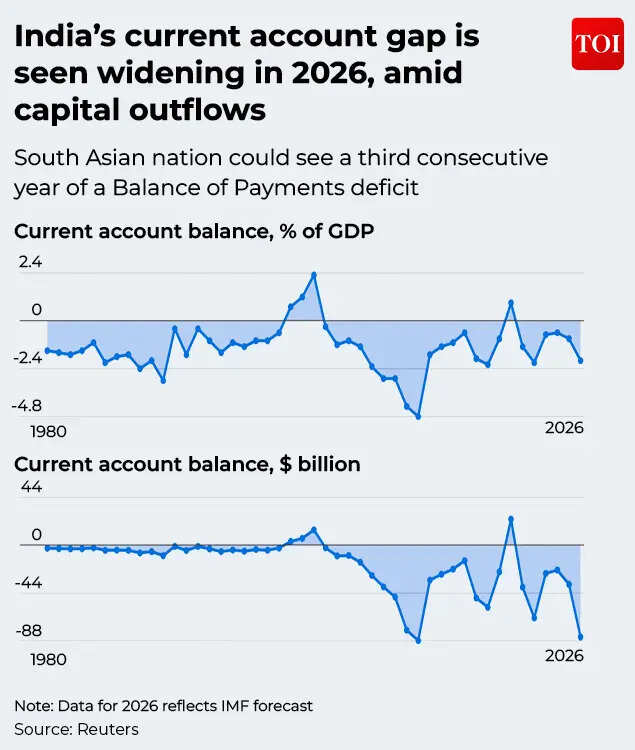
- The higher energy bill is expected to significantly widen India’s current account deficit. Economists estimate that India’s current account deficit could rise to 2.5% of GDP in FY27 from 0.9% in the previous year, Reuters reported.
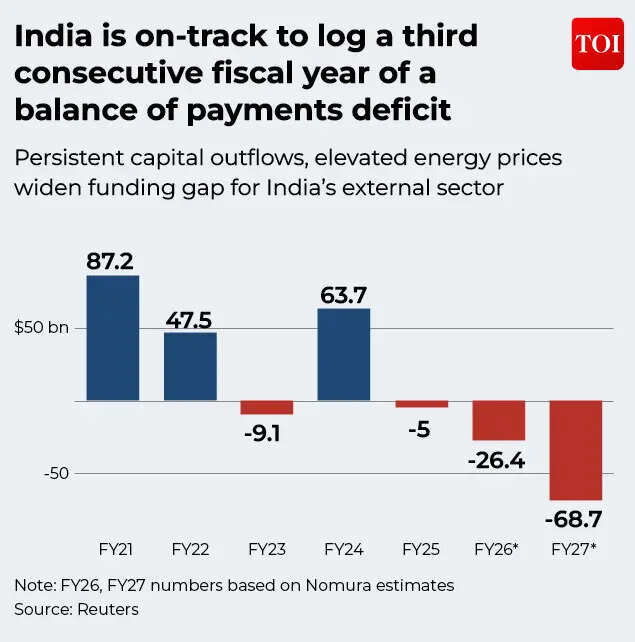
- India’s overall Balance of Payments deficit is also expected to widen to between $65 billion and $70 billion this year, marking the third consecutive year of deficits.
- HSBC noted that India “faces a two-fold challenge…to lower the current account deficit and attract capital inflows that are sustainable.”
- Higher oil prices are already affecting India’s trade balance. The country’s merchandise trade deficit widened to $28.38 billion in April, largely due to a surge in crude oil imports to a six-month high.
- India’s heavy dependence on imported crude oil has historically kept the country’s oil trade deficit elevated. According to a CRISIL report, while oil import volumes have steadily increased over the years, exports of refined petroleum products have remained largely flat, except during the post-pandemic surge
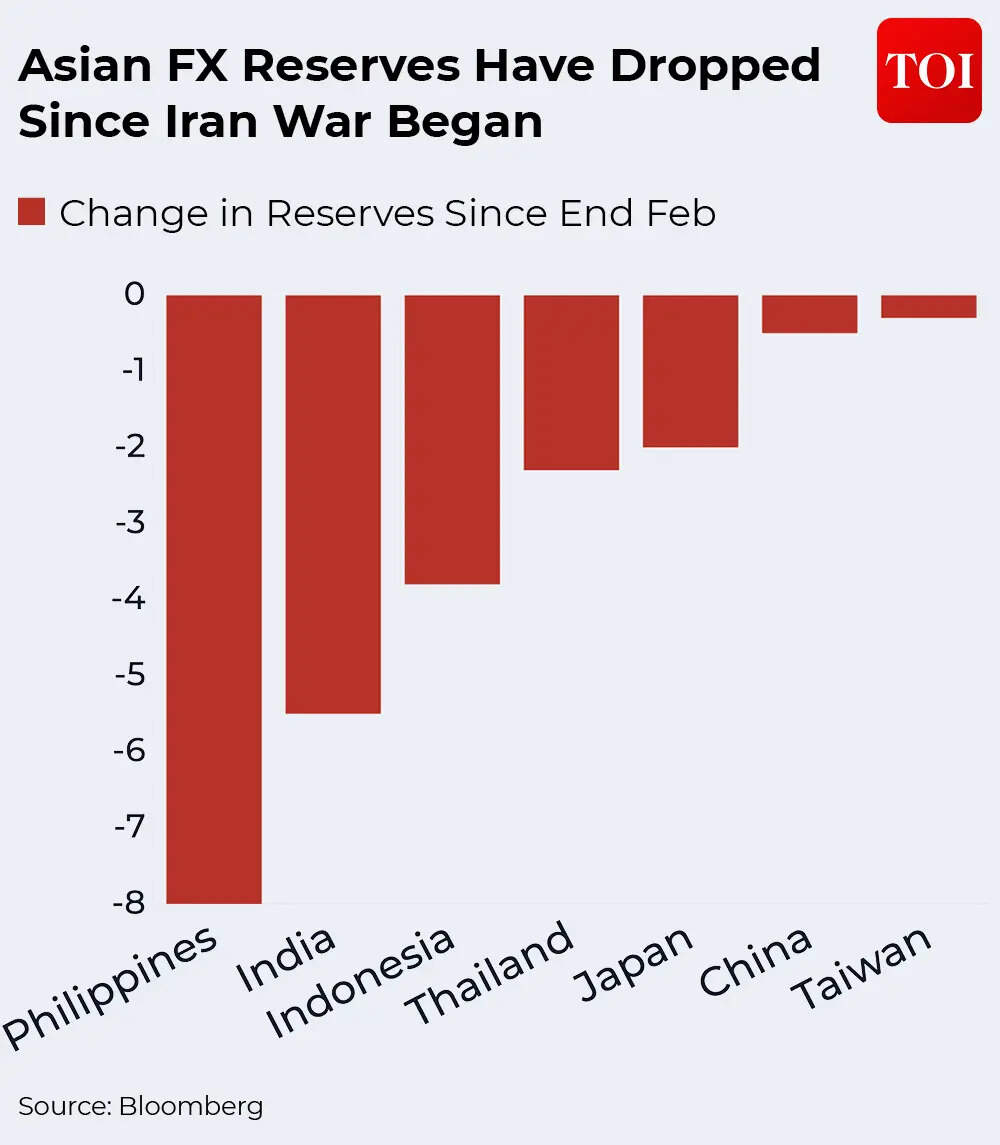
- Adding to concerns over India’s current account, is the fact that the capital account is also coming under pressure. This is due to an unprecedented pace of foreign portfolio investor withdrawals. Since the outbreak of the Iran conflict, overseas investors have withdrawn more than $20 billion from Indian equities. This takes the total outflows in 2026 beyond the record levels that were seen last year.
- It is this pressure on both fronts that has begun reflecting sharply on the currency market. The rupee has weakened by over 5% since the Iran war started.
Radhika Rao, Executive Director and Senior Economist at DBS Bank tells TOI, “Barring a sharp improvement in the portfolio flows and the net FDI math in the second half of the year, the balance of payments is likely to register a deficit for the third consecutive year. This sets the stage for slower reserve accretion and further rupee underperformance.” “The health of India’s current account has improved notably in the past few years, with the growing services surplus helping to offset the goods imbalance, while also getting a hand from resilient remittances. The energy shock and associated market volatility is set to impact both sides of the BOP equation, jump in the import bill, while investors adopt a cautious view on asset markets,” she adds.Ranen Banerjee, Partner and Leader, Economic Advisory, PwC India explains that the strong invisibles in terms of remittances and robust service exports have been supporting us to meet the deficits on the current account and keeping our BoP under control. “The risks emanate from a dip in the remittances, risk to services exports emerging from the emergence of AI and export headwinds from tariffs and geopolitical conflicts,” he says.The last time the BoP saw consecutive net deficits was the one we last experienced in the aftermath of the global oil crisis of the 1970s.
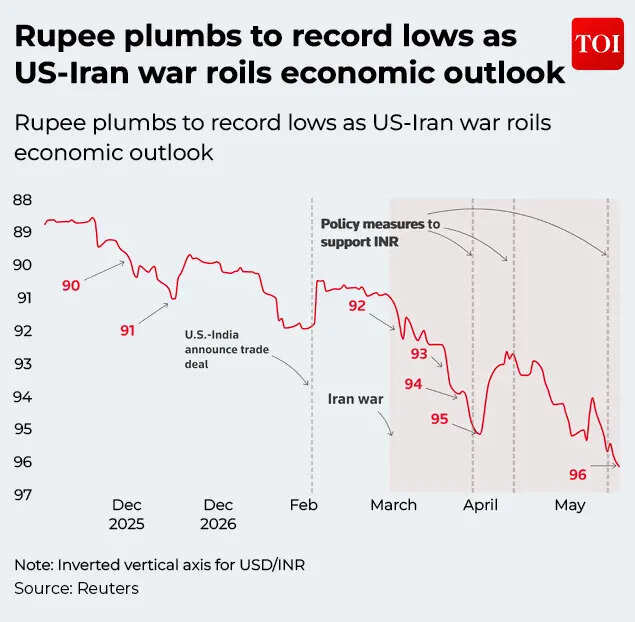
For Vivek Kumar, Economist at QuantEco, the stress on BoP is predominantly on account of the global pivot on capital flows in the post-COVID era, marked by rising protectionism and redrawing of the global supply chain. At the current juncture, widening pressures on the current account deficit due to high energy prices amidst the ongoing Middle East crisis have added further risk to the BoP. “We expect the rupee to weaken towards 96.5 before the end of FY27. However, the lingering Middle East crisis without any credible signs of de-escalation could accentuate the depreciation risks. Targeted policy interventions by the RBI and the government could help alleviate the stress,” he tells TOI.DK Srivastava, Chief Policy Advisor, EY India warns that India’s balance of payments position is beginning to reflect some changes in the current environment. The crisis is ongoing. “If it is a test, India may not come out on top as the pressures on India’s balance of payments arise from deep seated and structural forces governing the global economy and trade,” he tells TOI.What is feeding into the economic uncertainty is clear: India imports nearly 90% of its crude oil requirement and nearly 60% of its LPG requirements. These are subjected to both price and supply shocks in the context of a structurally changing global economic and trade order. “Hence, this development could have implications for India’s growth trajectory in the short to medium term,” Srivastava says. The EY expert sees some deterioration in CAD in the final quarter of 2025-26. However, it may still remain below 2% of GDP in 2025-26.“Given the sharp rise in crude oil prices, globally and in terms of India’s crude basket price, it may come close to 2% of GDP in 2026-27. The sustainable level of CAD as % of GDP has been estimated at 1.3%,” he says.India’s economic history shows how important external sector stability is. According to the Ministry of Statistics, six major events significantly shaped India’s Balance of Payments between 1951-52 and 2011-12:
- The 1966 rupee devaluation
- The oil shocks of 1973 and 1980
- The 1991 balance of payments crisis
- The 1997 East Asian crisis
- The Y2K technology boom of 2000
- The 2008 global financial crisis and Eurozone crisis
Among these, the 1991 crisis remains the most significant. The episode demonstrated how vulnerable an economy can become when external imbalances remain unchecked.
Is a structural crisis looming?
Yet another statement of the CEA which has stood out in recent days is his view that the Middle East conflict exposure for India is ‘structural’’. He has also warned that data readings will not ‘self-correct’ once the situation gets better. This raises the important question: how sound are India’s economic fundamentals to overcome this global crisis?“What we are experiencing is not a crisis within the system. It is a structural challenge to the organising principles of the system itself,” he has said.Nageswaran has highlighted four structural shifts that he believes are reshaping the global economy. These are; technology bifurcation, energy transition being used as industrial policy, geo-economic fragmentation, and geopolitical risk. He says that India needs to be prepared for this ‘structural challenge’ that is reshaping trade and capital flows. He sees the need for India to be prepared for a prolonged phase of geopolitical fragmentation, technology bifurcation and elevated energy risks.Experts that TOI spoke to expressed confidence in India’s fundamentals, though warned that a prolonged conflict in the Middle East will deal a blow to the economy.Ranen Banerjee of PwC says the fundamentals of the Indian economy are strong. “We currently have lower inflation numbers and hence a headroom to absorb price increases with inflation still staying within the RBI’s tolerance band. The corporate and bank balance sheets are healthier and hence can absorb some economic stress induced NPAs. The fiscal is in good shape so the government can increase some spending to support the economy through a slightly higher fiscal deficit,” he says.
The ongoing Russia-Ukraine conflict had also disrupted supply chains. India had to some extent anticipated the growing challenges to free and multilateral global trade by undertaking a number of critical bilateral trade agreements and by playing an active role in expanding the BRICS group of countries so that intra-BRICS trade can be promoted and India’s dependence on uncertain sources of critical imported inputs could be reduced. EY’s Srivastava feels that the West-Asian crisis has accentuated the BoP crisis for India in particular and for the Indian economy in general, exposing its vulnerability to global shocks. “This calls for recalibration of our growth strategy, if we are to continue to target a Viksit Bharat status in about two decades from now. There are early signs of pressure, particularly in the form of rupee depreciation and tightening current account deficit and fiscal deficit positions,” he notes.Fundamentally, he warns that there is a longer-term and structural problem that needs recalibration of India’s Aatmanirbhar strategy of Industrialization in the context of growing geopolitical and geoeconomic risks.“Structurally, both fiscal consolidation and sustainable level of current account deficit paths will have to be recalibrated and their adverse impact on the economy need to be studied and minimised. In particular, domestic policies are needed to mitigate pressure on fiscal deficit and externally, India’s share in intra-BRICS trade as well as the currently active bilateral trade agreements will have to be expanded sharply,” he advocates.As CEA Nageswaran has said: “Managing the current account credibly, financing it and preventing further currency depreciation are the central macroeconomic imperatives of FY27. India’s fiscal consolidation path, infrastructure investment and the reform record of recent years provide the foundation.”