


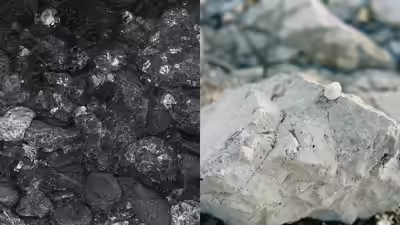
Scientists involved in planetary formation studies, meteorites, and early solar system investigations have been wondering about the origins of the ingredients that made up the planet Earth. Studies on carbonaceous chondrites, isotopic compositions, and planetary accretion have shown that the elements needed for life on Earth, such as carbon, water, and volatiles, could have come from primitive meteorites that developed in the outer solar system. These studies have contributed to the understanding of how terrestrial planets acquired their life-giving ingredients. Scientists are finding clues to the chemical makeup of Earth through studies of isotope ratios of certain elements like molybdenum and hydrogen.
Meteorites and the origin of Earth’s building blocks
Meteorites, especially carbonaceous chondrites, have become invaluable sources to shed light on Earth’s origin story. As the most primitive materials of our solar system, these space rocks are important in terms of studying Earth’s origin. In their research paper entitled ‘The source of hydrogen in Earth’s building blocks‘, the researchers mention that “these materials preserve a record of the early solar system’s chemical evolution”, as well as water and organics vital for sustaining life.Isotopic fingerprints have been the main point of interest of scientists, as they can help trace the source of Earth’s components. The isotopic composition of molybdenum in Earth’s mantle resembles the composition of the same isotope in particular meteorites, indicating a common source of both. The researchers mention that these fingerprints indicate “genetic links between Earth and carbonaceous chondrites.” It means that not only was Earth made of locally sourced materials.
Role of the early solar system and planetary accretion
The formation of our solar system was a very active process where dust, gas, and planetesimals collided and merged with each other. The formation of the Earth followed a similar path, called planetary accretion. Recent scientific findings, obtained via isotope analysis, show that the material from both the inner and outer solar systems was mixed in the course of planet formation.This conclusion is based on research published in Science Advances which notes that “the accretion of carbonaceous material contributed significantly to Earth’s volatile inventory, including water.”It contradicts the old assumption that comets brought all the water onto Earth’s surface. It seems that objects similar to asteroids but with high content of water and organic compounds have contributed largely to Earth’s formation.One possible cause of this mixing might be the migration of giant planets such as Jupiter that scattered the materials of the outer solar system elements across enormous distances.
Isotopic evidence and chemical fingerprints
The isotope analysis has been established as one of the most powerful tools for studying the planets. It involves comparison of isotopes of some elements, such as hydrogen, nitrogen, and molybdenum, to trace the source of materials that make up the planet.In a paper entitled, ‘Potassium-40 isotopic evidence for an extant pre-giant-impact component of Earth’s mantle’, it is clear that Earth’s isotopic composition comprises a mix of various reservoirs because, as the authors put it, ‘Earth accreted from a mixture of non-carbonaceous and carbonaceous.’ It makes it clear how Earth got all its elements of construction and even its volatiles that would eventually contribute to the development of life on Earth. It also clarifies why there were water-bearing minerals in the composition of meteorites, possibly forming oceans on Earth.
Implications for life and planetary science
The study of the origin of the materials used in making up Earth is significant because it holds keys to understanding the search for life in outer space. For example, if basic substances like water and carbon can easily be deposited via natural processes like the collision with meteorites, the possibility of the existence of life in the universe is greater than ever before.Moreover, the discovery makes clear how intimately related the entire solar system is. Earth is part of a larger process that includes the transport of substances from one point to another on an enormous scale.Through further research into meteorites and improving isotopic methods, the origins of Earth will become even clearer as they unfold. In the end, life is made possible due to local and cosmic inputs into Earth’s formation.