


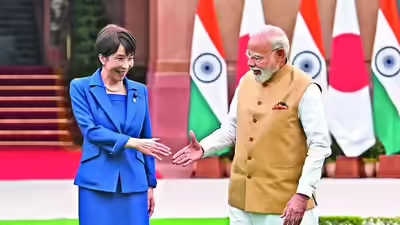
NEW DELHI: Japan PM Sanae Takaichi’s visit to India for the India-Japan summit heralded what her counterpart Narendra Modi described as a new chapter in their special strategic and global partnership, with both sides signing several agreements to boost cooperation in AI, energy security, mineral exploration and defence. The leaders also adopted a roadmap for economic security to boost supply chain resilience in strategic sectors like semiconductors and critical minerals, while agreeing to review the 15-year-old India-Japan CEPA to enhance and diversify bilateral trade.Building upon his remarks at the G7 summit about the sanctity of mutual trust amid the global turmoil, Modi said India-Japan relations exemplified a relationship based on unbreakable reciprocal trust.Amongst the highlights was also an announcement by Modi about India and Japan signing their first co-development project for the Unified Complex Radio Antenna (UNICORN) that, the PM said, will open another new chapter in the defense technology partnership.“Now, we will together develop such defence technologies that will strengthen regional peace, maritime security, and rule-based order,” said Modi, talking about the UNICORN partnership that is expected to boost naval stealth. The announcement follows Japan’s relaxation under Takaichi of self-imposed restrictions on defence exports.During the joint press statement after the meeting, Modi addressed Takaichi as his choti behen (younger sister) and the Japanese PM reciprocated by saying that both leaders were on the same page and would look to develop this relationship of brother and sister.On economic security, which dominated the summit agenda, the leaders reiterated in a joint statement their grave concerns over the use of “economic coercion and non-market policies and practices, including arbitrary export restrictions that may lead to supply chain disruptions particularly in critical minerals and critical industrial sectors, and price manipulation”.Amid global concerns over China’s dominance of the critical minerals sector, Modi and Takaichi underscored the importance of diversified, resilient and reliable global supply chains, a fair competitive global environment, and the need to avoid reliance on any one country, according to the joint statement. In that regard, foreign secretary Vikram Misri later said the leaders discussed the need to maintain strategic autonomy and resilience.The meeting also saw Modi and Takaichi agreeing to make the India-Japan CEPA more “forward-looking” to ramp up the modest bilateral trade volume of about $ 27.5 billion dollars. Modi said that the India-Japan investment partnership is steadily growing and that the over 100 business agreements signed in the past 1 year will bring $ 10 billion in Japanese investment to India.“Our goal is clear: to attract 10 trillion yen in investment from Japan to India and to double the number of Japanese companies in India over the next 10 years,” said Modi, adding that continuous reforms in India have improved the ease of doing business, and Japanese companies can also take advantage of this. In the 2025 summit in Tokyo, India and Japan had agreed to Japanese investment worth 10 trillion yen into India over the next decade.Apart from joint declarations on economic security and energy resilience, the 2 sides also issued a joint statement for cooperation in AI.Reiterating the significance of a free, prosperous and rules-based Indo-Pacific for both India and Japan, Modi said that the technology partnership would serve as the strongest pillar of India-Japan collaboration.“The convergence of Japan’s precision technology and India’s software capabilities will impart new momentum and strength to global AI development,” said Modi.To deal with possible oil shocks in the future, the 2 sides also announced a roadmap for energy resilience. This includes dialogue on national stockpiling systems and reserves, coordination regarding arrangements with producing countries and emergency response and market stabilization.Modi said that both sides have also prepared the India-Japan Next Generation Mobility Partnership Framework. “With this, we will now repeat our success story in the automotive sector in areas such as shipbuilding, aviation, and logistics…the great strength of our relations is our people-to-people tie. We are also increasing opportunities for talent, mobility, skilling, and technical internship programs,” he said.
India’s Tokyo drift: PMs open ‘new chapter’ in ties with tech, energy and defence focus | India News
 Unesco Warns Pakistan Over 'Reconstructions' At Taxila, Threatens Danger List