

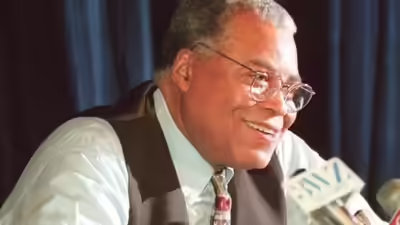
James Earl Jones has one of the most recognizable voices in cinema. That deep, commanding voice that fills every room. He’s been in countless films and television shows. He’s won major awards across theater, film, and television. He’s been nominated for Academy Awards. He’s played Darth Vader. He’s played kings and presidents and fathers and villains. He’s been an actor for over six decades and somehow managed to stay relevant and respected throughout his entire career.But the role that might be his most iconic, the one that resonates with millions of people, is one where we never see his face. Where we only hear his voice. Where he plays a father teaching his son about the world. Do you remember his words? “Everything you see exists together in a delicate balance. As king, you need to understand that balance and respect all the creatures, from the crawling ant to the leaping antelope.”
Quote of the day by James Earl Jones
“Everything you see exists together in a delicate balance. As king, you need to understand that balance and respect all the creatures, from the crawling ant to the leaping antelope.”James Earl Jones voiced this line as Mufasa in ‘The Lion King’. He’s standing on a cliff with his young son Simba, teaching him about the kingdom that will one day be his. He’s explaining that everything is connected. That there’s a balance to the world. That even as a king, even as someone with power and authority, you have a responsibility to respect all living things.And when Simba asks the obvious question, “But Dad, don’t we eat the antelope?” In response, Mufasa brings forth the idea of the Circle of Life. To Mufasa’s response comes the Circle of Life concept. When we die, our bodies are the grass, the antelope eat the grass, and we are all connected in the great Circle of Life.It’s a straightforward saying, but it’s said with so much authority and wisdom that it’s one of the most quoted lines in cinema history. Millions of people grew up hearing James Earl Jones deliver this line. And it shaped how they thought about the world.
What does it actually mean?
James Earl Jones as Mufasa is describing something that goes beyond just the food chain. He’s describing interconnection. Interdependence. The idea that nothing exists in isolation. Everything affects everything else. You can’t exploit one part of the system without affecting another part. You can’t ignore the small creatures because they matter. You can’t disrespect anything because it’s all part of the same whole.This is the kind of wisdom that usually comes from someone who has lived long enough to see the consequences of ignoring it. Mufasa is an older lion. He’s been king. He’s learned that power without responsibility is just tyranny. Understanding your place in the larger system is what makes you a good leader.The part about respecting all creatures from the crawling ant to the leaping antelope is crucial. He doesn’t just say respect the big, impressive animals. He specifically mentions the ant. The smallest creature. The one most easily overlooked. The one that seems insignificant. But Mufasa is saying it matters. Everything matters. Every creature has a role to play. Every part of the system is important.In the context of ‘The Lion King’ this becomes the foundation for everything that happens in the film. The whole tragedy of the story comes from Scar’s refusal to understand this balance. He creates an imbalance. He overrules nature. And the entire kingdom suffers as a result. The grasslands wither. The animals leave. Everything falls apart. Because when you break the balance, there are consequences.But the broader meaning extends far beyond just the movie. James Earl Jones is delivering a message about how the world actually works. About how we’re all connected. There is the ripple effect that what we do has, about, extends far beyond what we can see. About the fact that power and authority come with responsibility; that even as a king, you are part of a system which you must respect and work within.It’s a message that feels especially relevant now. Because so much of modern life is about ignoring that balance. About acting as if we can extract and consume without consequence. About treating nature, other creatures, and other people as if they don’t matter as long as we get what we want. And Mufasa is saying that’s backwards. That’s how kingdoms fall. That’s how entire systems collapse.
Who is James Earl Jones?
Born Robert Earl Jones in 1931 in Arkabutla, Mississippi, James Earl Jones became one of the most distinguished and respected actors in entertainment history through his incredible range, his distinctive voice, and his powerful presence in every role. According to IMDb, he began his career in theater before transitioning to film and television, bringing the same level of excellence to every medium he touched. He became iconic as Darth Vader in the ‘Star Wars’ series, with his voice work. He was very skilled at dominating a scene with his voice as he did in ‘The Hunt for Red October’, ‘Field of Dreams’, ‘Conan the Barbarian’, ‘The Sandlot’, and many other films.He’s a prolific actor and director in film and television. He has been in movies such as ‘Claudine’, ‘The Greatest’, ‘Coming Home’, and many others. He’s done voice work for animated films and shows. He has been the recipient of significant awards in various forms of entertainment, and he’s been nominated for Academy Awards. He has been honored by several organizations for his exceptional contributions to the arts with both awards and lifetime achievement honors.But surely his most popular acting part was that of Mufasa in ‘The Lion King’. The movie hit theaters in 1994 and was a cultural phenomenon, and one of the most successful animated movies of all time. James Earl Jones added gravitas, wisdom, and authority to the role of Mufasa. The way he spoke, a deep voice with a strong command of the delivery, made every line important, every lesson necessary. When he explained to Simba about the Circle of Life, about the balance of nature, people believed him. They listened. They learned.Such a role has been a significant one. It was a story that millions of children had to deal with as the voice of their father. This was his version of Mufasa and was accepted as the standard. Mufasa was one of the best animated dads because he knew how to make his son laugh, he knew how to give him advice, and most importantly, love and care. Decades later, when people think of Mufasa, they hear James Earl Jones’ voice. They recall his teachings on balance and respect, and the Circle of Life.