

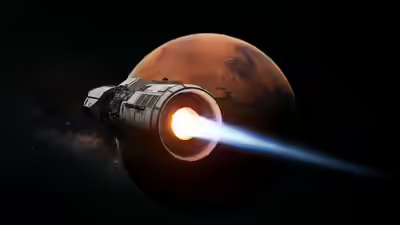
A technology that could propel crewed missions to Mars and robotic spacecraft throughout the solar system was recently put to the test at NASA‘s Jet Propulsion Laboratory in Southern California. The result was a milestone that engineers and space scientists have been working toward for decades, and one that brings the prospect of humans setting foot on Mars meaningfully closer to reality. For years, the central obstacle to crewed deep space travel has not been ambition or funding but physics, specifically, the brutal mathematics of how much fuel a chemical rocket must carry to move a crewed spacecraft across hundreds of millions of kilometres of space. What JPL demonstrated in February 2026 suggests that the gap is finally beginning to close. The test did not make a Mars mission imminent, but it made one plausible in a way that even cautious engineers are finding difficult to dismiss.
NASA ‘s Mars thruster test sets a new US power record for human missions
On February 24, 2026, NASA put its new magnetoplasmadynamic (MPD) thruster to the test in a specialised water-cooled vacuum chamber at JPL’s Electric Propulsion Lab. During the test, engineers fired the thruster five times and observed as the tungsten electrode at the thruster’s centre burned bright, reaching temperatures above 2,800 degrees Celsius. The tests successfully set a new record in the United States of 120 kilowatts of power, estimated to be 25 times greater than the thrusters aboard NASA’s Psyche spacecraft, which is currently en route to asteroid 16 Psyche and contains the most powerful electric thrusters NASA has ever flown. That comparison matters. Psyche represents the current ceiling of what NASA has managed to put into operational space flight. The fact that this new thruster dwarfs it in the test chamber is an indication of how significant the leap forward could be, not just incrementally, but in terms of what class of mission suddenly becomes conceivable.
What makes this thruster different from anything NASA has flown before
To understand why this test is significant, it helps to understand what electric propulsion actually is and why it is considered the most likely route to getting humans to Mars efficiently.Electric propulsion is not new at NASA. The agency is already flying solar electric thrusters on missions such as Psyche. Those systems use electricity to accelerate propellant and can cut propellant use by as much as 90 per cent compared with traditional chemical rockets. The tradeoff is that thrust chemical rockets produce a powerful shove. Electric propulsion, by contrast, builds speed gradually and continuously, which makes it poorly suited to launch but extraordinarily well suited to the long stretches of deep space travel where steady acceleration over weeks and months translates into genuinely impressive final speeds.Unlike conventional electric thrusters, which use electric fields to accelerate ions, MPD engines harness both electric currents and magnetic fields to generate thrust, enabling significantly higher power operation. That distinction is what allows the lithium-fed MPD thruster to operate at power levels that leave current ion drives behind. The lithium metal vapour propellant, which burns at extreme temperatures inside the chamber, is central to this advantage, as it allows the system to handle power inputs that would destroy conventional thruster designs. The concept behind MPD thrusters is not new it dates back to research efforts from the 1960s, but turning theory into a viable propulsion system has taken decades of incremental progress. What JPL has now demonstrated is that the engineering has finally caught up with the physics.
The numbers behind a Mars mission
The February test was a proof of concept rather than a finished product, and NASA is clear about that. According to NASA JPL, the team aims to reach power levels between 500 kilowatts and 1 megawatt per thruster in the coming years. Because the hardware operates at such high temperatures, proving the components can withstand the heat over many hours of testing will be a key challenge.The scale of what a crewed Mars mission would actually require puts that challenge into sharp relief. As Phys.org reports, a future human mission to Mars will require 2 to 4 megawatts of power, consisting of several thrusters and requiring more than 23,000 hours, roughly 958 days, or 2.6 years of continuous operation. That is not a sprint. It is a sustained endurance test of hardware operating in one of the most hostile environments imaginable, at temperatures that would destroy most materials and in a vacuum where there is no possibility of in-flight repair.The 120-kilowatt result from February is therefore a first step rather than a finished answer. But it is a first step that has validated the core approach, confirmed the design can operate stably at record power levels, and produced data that will directly inform the next series of tests. In engineering terms, that is exactly what a successful proof-of-concept test is supposed to do.
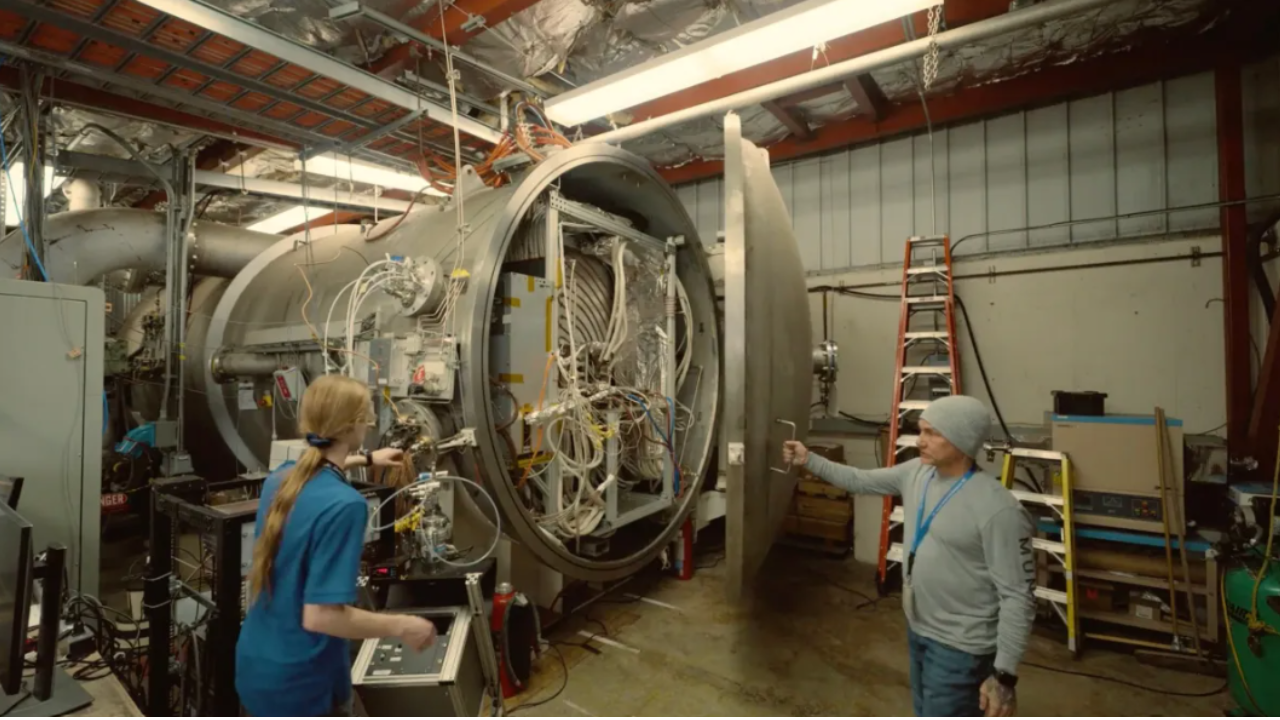
Image: NASA/JPL-Caltech
Why getting to Mars faster actually matters
There is a tendency to frame faster Mars transit as a matter of convenience or ambition. It is, in reality, a medical and operational necessity. Every additional day a crew spends in deep space increases their cumulative exposure to cosmic radiation, a risk that current shielding technology can only partially mitigate. Muscle deterioration in microgravity, psychological strain from isolation, and the compounding probability of mechanical failure all scale directly with mission duration.Electric propulsion is built for steady acceleration rather than explosive liftoff power. After a week in space, a spacecraft using this system would be racing through the solar system at more than 400,000 kilometres per hour. That kind of velocity, sustained over the course of a Mars transit, compresses journey times in ways that chemical rockets simply cannot match without carrying fuel loads that would make the mission impractical to launch in the first place.