


Around 70% of all El Nino years since 1980 have corresponded with poor summer monsoons, showing that the link between the Pacific condition and the country’s June-Sept rains is one of the strongest among global weather phenomena impacting India’s rainy season. The link assumes importance in light of latest forecasts from US and European weather agencies that have advanced the likelihood of El Nino setting in within two-three months and said it’s expected to be stronger than what earlier forecasts suggested. In it’s monsoon outlook, IMD says the season’s rainfall is expected to be below normal.
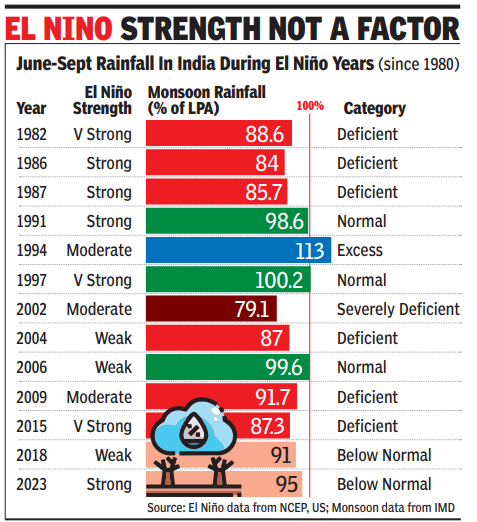
TOI analysed all El Nino years since 1980 – as defined by US agency NCEP – and the corresponding monsoon performance. Of the 13 such years, the monsoon was deficient or severely deficient (below 90% of long period average) in seven, below normal (90-96%) in two, normal in three and excess in one. Of the two below-normal years, rains in 2018 was close to deficient (below 91%). According to IMD, which uses a different metric to define El Nino years, there were eight such years during which the monsoon was deficient in six, including one year (2002) when it was severely deficient (rainfall below 80% of LPA). In addition, there have been years such as 2014, when rising heat in the Pacific impacted monsoon although El Nino finally didn’t develop. During an El Nino, there’s unusual warming of surface waters in eastern and central tropical Pacific which leads to changes in wind patterns that impact weather across the globe in different ways. There are notable exceptions when monsoon turned out to be normal despite an El Nino. The most cited example is 1997 which saw one of the strongest El Ninos on record, but June-Sept rainfall in India remained normal. That year, conditions in Indian Ocean – a phenomenon known as Indian Ocean Dipole – strongly favoured good rains over India and is thought to have countered the effects of El Nino. There’s consensus among global agencies over the possibility of El Nino forming this summer. European agency ECMWF projects a high probability of the condition developing in May-June and going on to strengthen into a very strong event – dubbed a ‘super El Nino’ by some – by the year end.